Translate

Wednesday, July 29, 2015

Father Leonid of Ukraine

 
This is a testimony given in 2010 at the priest's retreat in Medjugorje, by Father Leonid of Ukraine
 
Priest Leonid, Redemptorist from Ukraine province, participated in the 15th International seminar for priest in Medjugorje and gave this testimony, first to the other participants and then to Radio Station Mir Medjugorje. We publish the testimony as it was given:

My first pilgrimage to Medjugorje was related to my obligations and to my occupation in the priestly vocation. Namely, in 2005 my local Church entrusted me with huge responsibility and gave me a heavy burden to carry and that was in the service of exorcist.
 
The first months and the very first year were filled with God's love and grace, but also with great difficulties and temptations. One of the major difficulties took place during a session of exorcism over one possessed person. That person spoke to me in a very rough voice, full of horror in these words: "I am horrible, I am powerful, and I will destroy you. I will destroy your priesthood and all of your life."
 
Although that was quite bad, I did not take that seriously at all. After all, I believed in God completely and I did not have any reasons to doubt that. I also knew that if I had fear in front of the Satan that would be as if I had already lost something. But God allowed this situation to take place, and I am going to share with you how great and how mighty his Mother is, and how Medjugorje is sacred ground.

When I was in great pain, when I suffered and when I was tempted daily, I was not able to pray at all. I would go to confession every single day, but Satan tempted me all the times. The temptations were so strong that I lost peace in my soul completely. And not only that, I also felt that I lost my priesthood and my vocation. I felt that it was a complete and total destruction of my life.
 
In that difficult reality, while I was still unable to figure out what was happening to me, somebody offered me to come to Medjugorje. And I came. I was with a group of priests. I was just not able to pray, not even when they prayed. During that pilgrimage I met one other priest, Father Ambrosias from Slovakia. 

He completely sacrificed his life and his vocation working with people from Ukraine in the region of Carpatho - Ukraine. He traveled soon after heart attack, and he also had diabetes. He was a Franciscan priest who came to Medjugorje five times before that. He absolutely thrilled me with his life and humbleness. He became my friend, I would help him around, take him by the hand, as he was an older man. It appeared that I was helping to him, but in truth was it was the other way round.
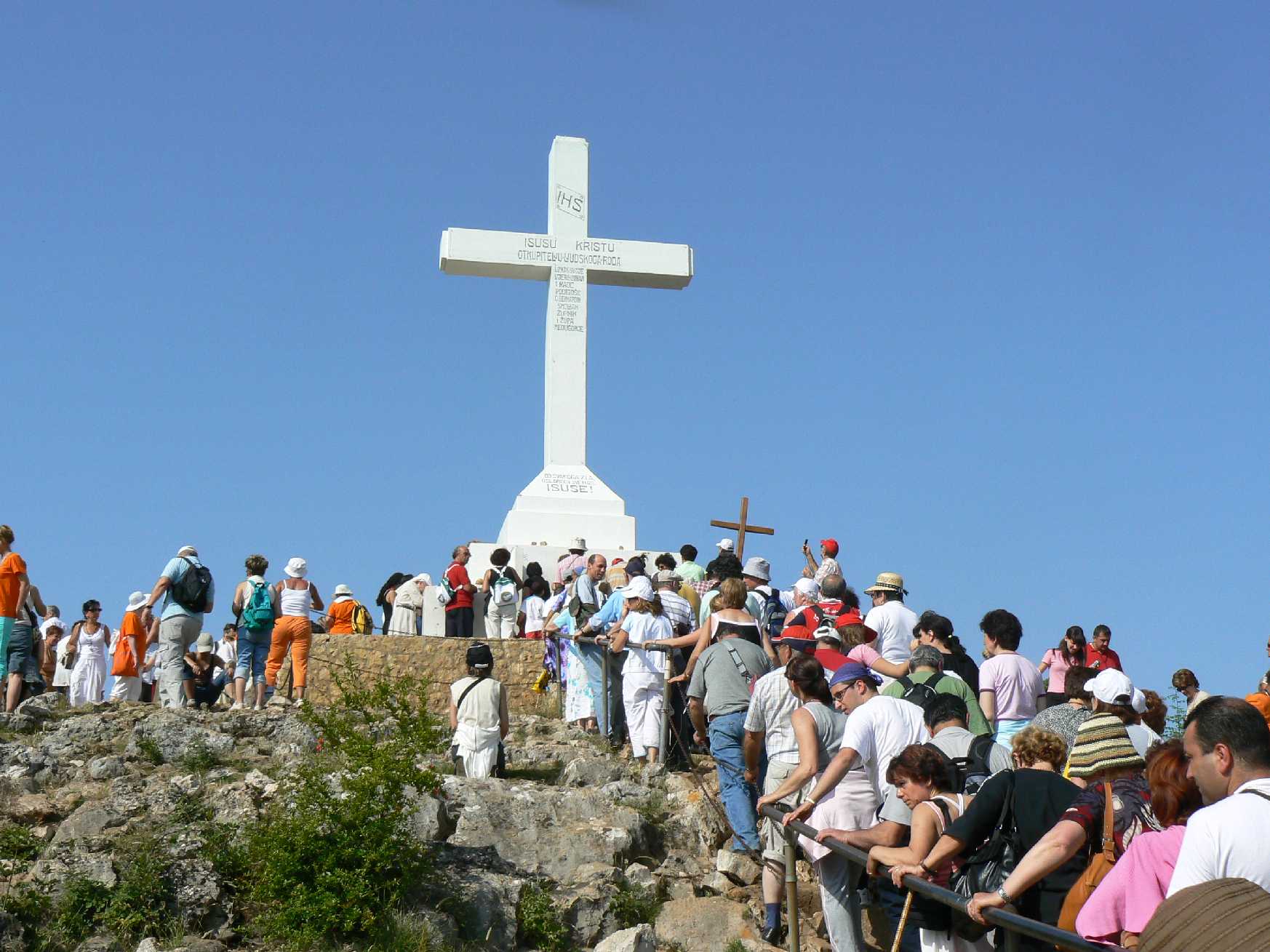
We were once climbing up the Hill of Apparitions and it was to be the apparition to one of the visionaries. Everything was packed with people, priests. I sat next to Fr. Ambrosias and I turned my back to the apparition site. I felt myself not worthy of being there at all. But during the time of the Rosary, I felt a desire to look towards that direction, to see what was happening there. At the same time, as I felt that desire, another inner voice was saying to me not to look there. "You are failure and you will end up in hell", I heard. It was horrible.
 
Those first, positive feelings directed my look towards the apparition site. I started to look and I was searching for a sign. Maybe I was to see something at the end. Hope was being born in me slowly, but also more new arguments about how my humiliation was not to be changed. But, I believed in the crucial moment...just for a moment. And in that very moment, as the answer to all of the questions ever posed to me, I was able to feel how Our Lady was coming down, from Heaven to this world. It was horrible in that moment. Such a powerful perception, a scent of the other world [of evil] that I used to feel up to that point.
 
And then, I was appeased by certain gentleness, a light touch, like a gentle breeze of Our Lady's presence. She was coming closer to me. And as she drew closer to me, the power of evil was disappearing. In my heart I experienced new revelation. I was able to experience how powerful her presence is, how she was humble.  Then I realized that she does not cast away evil spirits, but they run themselves. They are not able to bear her purity and the beauty of her presence. She does not humiliate them nor does she send them away. She simply loves them and they cannot stand that!
 
And then, a change of spirits within me took place. The spirit of Satan, the spirit that destroys, disappeared with all of his depression and fear. Instead of that spirit, Our Lady's spirit took its place in me.

 In my heart, I heard the voice: 

"Do not be afraid, I am your mother! I am your guarantee that you will not be destroyed, that you will not fail." 

Everything was changed. That experience of presence of Our Blessed Mother became a miracle of love that saved me, my vocation and my life!
 
I started to feel Our Lady's presence in every exorcism I perform. I will just share one little example, since there are many similar ones. Our priests were dealing with one possessed girl who came to confess in front of one young priest who just returned after his studies in Rome. And as he was saying the absolution words, that person, Satan, in that girl, hit that priest so hard that he fell down immediately. Then, that same person started calling other priests in some strange voice. That priest was scared and he called me.
 
After few moments that girl was in front of me and I started to pray over her. As I began the exorcism, I knew the diagnosis straight away, the girl was severely possessed and I invited five devoted faithful to pray as well. As I recited the traditional prayers of exorcism, Satan just laughed. It spoke to me in the English language, humiliated me and constantly laughed at me.

 Then, I began to pray to Our Lady. I was totally exhausted. I began to be nervous as well. I felt that I need to finish my prayer, but the evil spirit was not going away. It was the spirit of suicide. I began to call Our Lady with all of my heart. In the same way as the child calls his mom. And real screaming began at that moment: "I cannot stay here any longer, Our Lady is here, I need to go away." 

And the demon fled from the mother of Jesus Christ the Savior of the world. 
 
This was just one situation and there are so many similar ones. During these five years, as I have been entrusted the service of exorcism, I experience many temptations and trials. I had those before; I know I will have those in the future as well. But, Our Lady keeps me in her heart. 

 I desire to be in Medjugorje and Jerusalem every year. That is what faith is for me. Here I have faith, blessing and grace. I am grateful to dear God that I am able to witness Our Lady's grace in this way. I would like each one of us to want to love more our Blessed Mother, the Mother of God. She is our Mother. She loves her children. 

She is prepared to do anything her children ask of her.  I offer a personal invitation to come to Medjugorje. To bring here all of those people who experience tremendous spiritual suffering.

Tuesday, July 28, 2015

Anthony Robinette Saved by GOD

 
A drug dealer and addict, Anthony Robinette had no intentions of pulling into a church parking lot.

 “That's where I heard a voice. My whole life changed right there.”
Anthony was raised by his mother and step-dad but didn’t know his biological father. He grew up going to church with his step-family but felt like an outsider.
“I always noticed there was something different. I just sorta felt you know, nobody really cared. I just didn't – I didn't feel that love.”

So Anthony began looking to fit in elsewhere.
“You start getting with crowds where you feel like, ‘Well, they like me, they accept me.’ And then you start doing the things they're doing.”

Anthony was 12 when he started stealing, fighting, and smoking marijuana. By the time he was 15 he was snorting cocaine.
 
“When I first got introduced to drugs, I was doing them at the time trying to fill the void. And some of it was a way to numb my pain. So I sorta just left home – began staying at whoever's house I could and I felt like the streets were more accepting than that roof was at my house.”

At 18, he found out the streets were just as harsh. A fire in town had been ruled an arson and one of Anthony’s so-called friends accused him as being the one responsible. Anthony was arrested and later found guilty. 

“Facing 40 years in federal prison and now I’m sitting behind bars questioning God thinking ‘If he's real, he knows I’m innocent.  Why would I be here?’ So if that's got anything to do with that Father, you know, then He's just as bad as my earthly father.  I want nothing to do with Him either.”

Anthony didn’t serve prison time, but was put on 10 years of supervised probation.

“It didn't change things other than the fact that I think I became worse then – hardened my heart even more.”

Over the next 15 years, Anthony sold and used drugs. He also married and had 2 children. But neither the money, a cocaine high, nor a family were ever enough.
“For me, I always just wanting that, that I meant something to somebody, and I never thought I did. I just felt like nothing; it didn't matter. What was the need to even live? Because I didn't mean – nobody would miss me.”

Then, one-day in October of 2007, Anthony was on his way to pick up a stash of cocaine, when he took a wrong turn into a church parking lot.

“That’s where I heard a voice. At first I heard my name and I was just like ‘What is going on?’  And didn't quite understand and it was just a voice that I heard say ‘You don't have to do what you're getting ready to do. I can provide all your needs.’ And I’m like, ‘I don't know what's going on. I don't want none of this. I don't want anything to do with church, anything to do with God.’ And He's like, ‘Anthony, I never hurt you.’ And I asked Him right there, ‘I don't even know if you're real. If you are real, kill me or change me.’ 

That's when I felt the void filled, that I felt the pain leave and I felt accepted. I felt loved and I felt a Father. That's what I had been missing all my life. There was no words to describe how I felt right then. Everything that I had been chasing for 35 years, I found in that instant.”

Saturday, July 18, 2015

Hope

Just a quick reminder...The End of the Church Age is near. The time is short. 

Are you right with GOD? 

Do you have your life in order? 

Where does your heart lie? 

IS this the world you want? 

Is there confusion or peace in your life?  

Pray and ask GOD to give you understanding.  You have been warned.

Tuesday, July 14, 2015

The End of the Church Age


Rabbi Chaim Kanievsky, a leading authority in mainstream Ultra-Orthodox Judaism, has been giving clear and unequivocal messages recently that the coming of the Messiah is imminent. He is urging Jews to make Aliyah as soon as possible. Aliyah, the Hebrew verb for “going up”, refers to immigrating to Israel, which is seen as higher spiritual action that can help herald in the coming of the Messiah.

It was reported that the Rabbi Kanievsky was presented with a pamphlet, written by Rabbi Yitzchak Ben Tzvi from the city of Bnei Brak, dealing with the End of Days and many other related prophecies.

 Rabbi Kanievsky, who is a pillar of the Jewish community and known for his authoritative books on Torah law, read the pamphlet carefully.  After a short consideration, he told those around him that the pamphlet needed to be distributed and that Jews living outside Israel should return to their ancestral land.
 
In yet another instance of Rabbi Kanievsky’s call for aliyah, author Rabbi Yekutiel Fisch revealed advice that was given to his cousin, a teacher at a prominent Lakewood Yeshiva who visited Israel recently and went to Rabbi Kanievsky to receive a blessing at the end of his visit.

The Rabbi told him that he should not leave Israel because the Messiah would be arriving very soon. The teacher responded that he had 700 students waiting for him in Lakewood. Rabbi Kanievsky told him that he must bring all of the students to Israel. Upon his arrival in Lakewood, the story spread quickly, creating quite an impression on the students who all revere Rabbi Kanievsky.
 
After a lifetime of deep study and contemplation Rabbi Kanievsky’s he is sure that the Messiah is soon to arrive. Rabbi Kanievsky’s prayer partner informed various media sites that the Rabbi is talking about the messiah “all the time.”

 Since last summer’s war in Gaza, the Rabbi has been spreading this message of imminent return. In one instance, Rabbi Kanievsky instructed a Jew from Argentina who asked for a blessing that he should “gather your family and come to Israel.  Otherwise, there won’t be enough room for you on the airplanes.
 

Sunday, July 12, 2015

How to Become a Saint


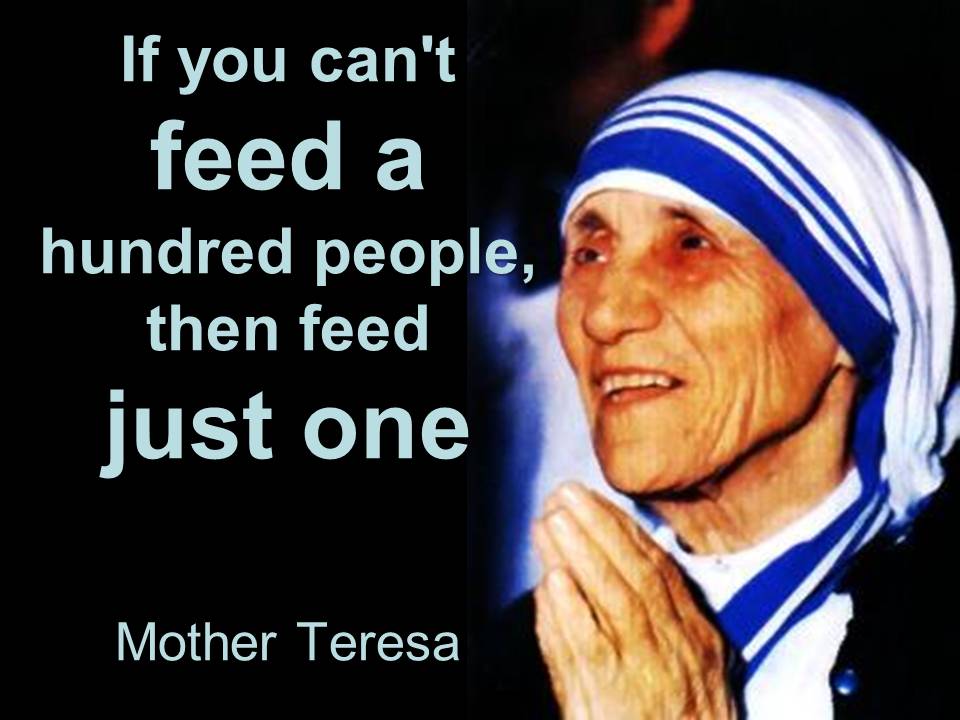
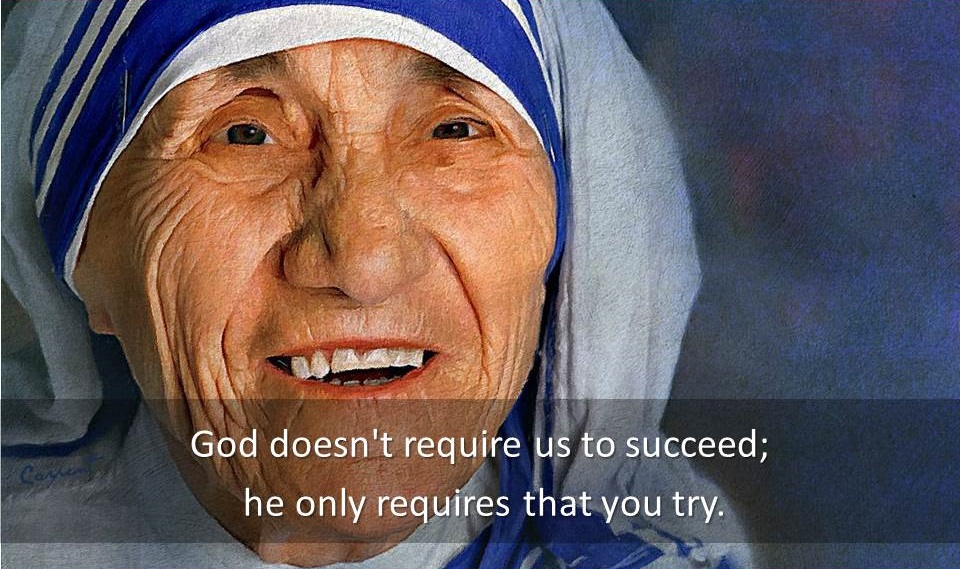
Born Agnes Gonxha Bojaxhiu on August 26, 1910, in Skopje, Macedonia, in the former Yugoslavia, she was the youngest of three children. In her teens, Agnes became a member of a youth group in her local pairsh called Sodality.

 Through her involvement with their activities guided by a Jesuit priest, Agnes became interested in missionaries. At age 17, she responded to her first call of a vocation as a Catholic missionary nun. She joined an Irish order, the Sisters of Loretto, a community known for their missionary work in India. When she took her vows as a Sister of Loretto, she chose the name Teresa after Saint Thérèse of Lisieux
 
 
In Calcutta, Sister Teresa taught geography and cathechism at St. Mary's High School. In 1944, she became the principal of St. Mary's. Soon Sister Teresa contracted tuberculosis, was unable to continue teaching and was sent to Darjeeling for rest and recuperation. It was on the train to Darjeeling that she received her second call -- "the call within the call". 

Mother Teresa recalled later, "I was to leave the convent and work with the poor, living among them. It was an order. I knew where I belonged but I did not know how to get there."   
 
In 1948, the Vatican granted Sister Teresa permission to leave the Sisters of Loretto and pursue her calling under the jurisdiction of the Archbishop of Calcutta.  
Mother Teresa started with a school in the slums to teach the children of the poor. She also learned basic medicine and went into the homes of the sick to treat them. In 1949, some of her former pupils joined her. 

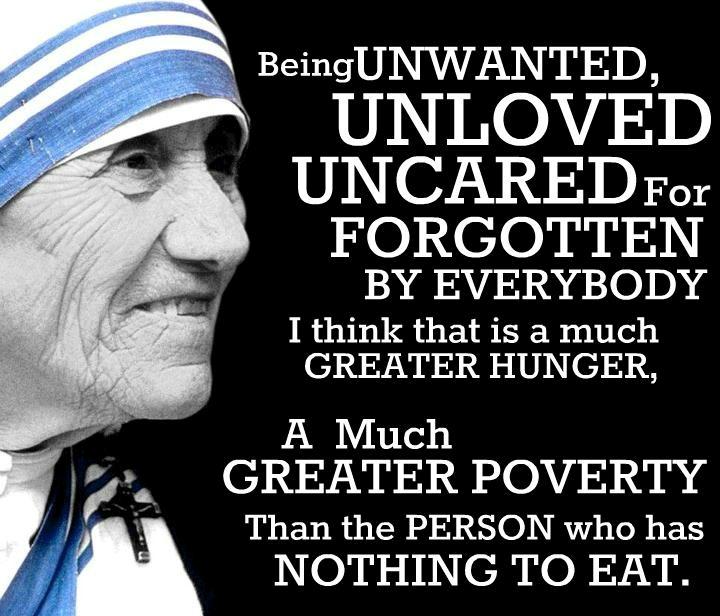
They found men, women, and children dying on the streets who were rejected by local hospitals. The group rented a room so they could care for helpless people otherwise condemned to die in the gutter. In 1950, the group was established by the Church as a Diocesan Congregation of the Calcutta Diocese. It was known as the Missionaries of Charity.  

 
In 1952 the first Home for the Dying was opened in space made available by the City of Calcutta. Over the years, Mother Teresa’s Missionaries of Charity grew from 12 to thousands serving the "poorest of the poor" in 450 centers around the world. Mother Teresa created many homes for the dying and the unwanted from Calcutta to New York to Albania. 

She was one of the pioneers of establishing homes for AIDS victims. For more than 45 years, Mother Teresa comforted the poor, the dying, and the unwanted around the world.  
 
In 1966, the Missionaries of Charity Brothers was founded. Homes began to open in Rome, Tanzania, and Australia. In 1971, the first home in the United States was established in the South Bronx, New York.   
 
Mother Teresa gained worldwide acclaim with her tireless efforts on behalf of world peace. Her work brought her numerous humanitarian awards, including : the Pope John XXIII Peace Prize and the Nobel Peace Prize in 1979. In receiving this award, Mother Teresa revolutionized the award ceremony.
 
 She insisted on a departure from the ceremonial banquet and asked that the funds, $6,000 be donated to the poor in Calcutta. This money would permit her to feed hundreds for a year.   
 
She is stated to have said that earthly rewards were important only if they helped her help the world’s needy.   
 
Beginning in 1980, homes began to spring-up for drug addicts, prostitutes, battered women, and more orphanages and schools for poor children around the world. In 1985, Mother Teresa established the first hospice for AIDS victims in New York. Later homes were added in San Francisco and Atlanta. Mother Teresa was awarded Medal of Freedom, the highest U.S. civilian award.   
 
In 1991, Mother Teresa returned for the first time to her native Albania and opened a home in Tirana. By this year, there were 168 homes established in India.  
On February 3, 1994 at a National Prayer Breakfast, sponsored by the U.S. Senate and House of Representatives, in Washington, DC, Mother Teresa challenged the audience on such topics as family life and abortion. She said, "Please don’t kill the child. I want the child. Give the child to me."   
 
Mother Teresa traveled to help the hungry in Ethiopia, radiation victims at Chernobyl, and earthquake victims in Armenia. Her zeal and works of mercy knew no boundaries. 

In November of 1996, Mother Teresa received the honorary U.S. citizenship.  On
March 13, 1997,
Mother Teresa stepped down from the head of Missionaries of Charity.  On September 5, 1997
Mother Teresa left this earth and was escorted into Heaven by a myriad of Angels with the Saints welcoming her with open arms.   
 
This is how one becomes a Saint...One day at a time, one life at a time, one smile at a time, one less tear shed...

Friday, July 10, 2015

5 yr old Dreams of Rapture

5 yr old boy has dream of Rapture.  What makes this an interesting dream is the fact that the 5 yr old boy in question has Asperger syndrome.

(AS): Asperger syndrome is an autism spectrum disorder (ASD) that is characterized by significant difficulties in social interaction and nonverbal communication, alongside restricted and repetitive patterns of behavior and interests. It differs from other autism spectrum disorders by its relative preservation of linguistic and cognitive development. 

The 5yr old boy in this case had NEVER ever heard of the Rapture and did not know anything about the coming event.  In this retelling another fact is that the boy had NEVER remembered any of his dreams before or since this Rapture dream.  

Add to the fact that the boy was told that this event would happen in September. Having no concept of time, days or months the boy was very exicted about the month of September, which leads to or next important fact. 
 
An interesting coincidence ; the Jewish High Holy Day Rosh Hashanna / Feast of Trumpets occurs September 13, 2015.  Now, add to that fact this year 2015 is the year of the 3 Blood moons, the Tetrad. 

 2 total solar eclipses will complement the 4 lunar eclipses on the Jewish New Year and the Feast of Trumpets September 13, 2015

When, asked of HIS return, JESUS said... “No man knows neither the day nor the hour wherein the Son of man returns.” (Matthew 25:13) 

The Feast of Trumpets is  holiday based on the sighting of the new moon.”“When Jesus said no one will know the day or the hour, it is believed that He’s is speaking of a future Feast of Trumpets because it is the ONLY Jewish feast where no one knew the day or the hour that it would begin because it is based on the sighting of the new moon.”

ALSO, occurring on September 27 2015 thru Monday Evening, October 5 The Feast of Tabernacles which is one of the "pilgrimage" festivals listed in Leviticus 23.  The 'Feast of Tabernacles' also goes by a number of other names: Feast of Booths, Sukkot (Hebrew for 'booths'), Feast of the Nations, and of course The Season of Our Joy!
 
The grains of sand are running out my friends...

Get right with GOD, before it is too late. 


Sunday, June 28, 2015

Radical Inclusiveness

From segregated churches of East Texas to destitute slums of India, the Rev. Charles Moore fought for human rights.

He delivered sermons about racism and sexism. He stood vigil against the death penalty. He went on a hunger strike to protest discrimination against gays and lesbians.

But during retirement, the United Methodist minister questioned whether he had done enough. He saw the broken world around him.

On a Monday afternoon in June, Moore, 79, drove from his home in Allen to Grand Saline, the town of his childhood about 70 miles east of Dallas. He traveled along country roads near fields of wildflowers and grazing cattle. In a strip-mall parking lot, outside a dollar store, beauty salon and pharmacy, he knelt down, doused himself with gasoline and lit himself on fire.
 
As flames engulfed him, he screamed and tried to stand. Witnesses rushed to put out the blaze with shirts, bottled water and, finally, an extinguisher.
He was flown unconscious to a Dallas hospital, where he died from burn injuries.

Moore had intended his act to be a grand but selfless gesture in the manner of Buddhist monks who have done the same before him.
 
“I would much prefer to go on living and enjoy my beloved wife and grandchildren and others, but I have come to believe that only my self-immolation will get the attention of anybody and perhaps inspire some to higher service,” he wrote in one of the notes he left behind.

He had considered doing it at Southern Methodist University, where he had earned a degree at Perkins School of Theology. He expected that his self-immolation would make national news and hoped his message of social justice would be broadcast along with his funeral.
 
But his final act drew little notice. A report in the Grand Saline Sun described him as an elderly man who seemed troubled. An article in the Tyler Morning Telegraph asked if he was a “madman or a martyr.”
He left his family and friends reeling from grief and trying to make sense of his death. At a memorial service Saturday at Faith Presbyterian Church in Austin, he will be remembered for the work he did — not for the way he died.

Charles Robert Moore was born July 18, 1934, on the outskirts of Grand Saline, home to about 3,000 people, numerous churches and a large salt mine. He saw the ministry as a path out of his family’s little frame house and the dusty farmland that felt confining.

In his notes, Moore said he found a home in the academic world of SMU, where he earned degrees in English and divinity. He was mesmerized by his schoolwork and inspired by his teachers at Perkins.
In the 1950s and 1960s, he worked at churches in suburban San Antonio and then in Carthage in East Texas.


It was a tense time in Carthage. Moore and the Rev. Jack Albright, another United Methodist minister, supported the civil rights movement. But people were afraid of integration, and some churchgoers called them communist sympathizers and racial slurs.
“He did not win a lot of friends — nor did I,” Albright said.


The ministers would meet at a coffee shop for a two-person support group.

“When people are raised and spend their life in an atmosphere of segregation, it’s very threatening to make changes,” said Albright, who retired in the East Texas town of Jacksonville. “The issue was how hard do you push, especially if you are going to create a lot of confrontation.”

But Moore was undaunted by popular opinion.
“He was very clear about where he believed the church should be about opening its doors to African-Americans and treating them like human beings,” Albright recalled.


Frustrated and tired, Moore enrolled in graduate studies at Boston University and Harvard Divinity School. In the mid-1960s, he moved with his first wife, Patricia, and two sons to inner-city Chicago, where he worked for the Ecumenical Institute to create economic and educational opportunities in troubled areas.
 

They opened a preschool, started a job training program and rebuilt a dilapidated neighborhood that had burned during riots after the assassination of the Rev. Martin Luther King Jr.
Later, Moore worked in a slum in Bombay (now Mumbai), India. He traveled to developing nations in Africa and the Middle East.

In his writings, he said his 12 years with the Ecumenical Institute exposed him to “the pallor of illness and poverty on a world scale.”
Among a group of optimistic advocates, Moore offered a “heavier and gloomier perspective,” said Terry Bergdall, now executive director of the Ecumenical Institute. He said Moore’s speeches were inspiring but not rosy. In one, he called himself a “fundamentalist for social justice.”


Moore returned to Texas in the 1980s, serving in various churches. In 1990, he went to Austin to lead the 100-year-old Grace United Methodist Church, with its six-person choir and dwindling congregation.
He fixed up the quaint old building, added stained-glass windows and hired a homeless man to be the groundskeeper. In sermons to the white-haired worshippers, he took up a new cause, welcoming gays and lesbians to the church and condemning their exclusion.

During his decade as pastor, the church started a pumpkin patch on its lawn, hosted a religion school for a Jewish congregation and opened its doors to a chapter of PFLAG, which held meetings for parents, friends and families of lesbians and gays.
The congregation began to grow.

Andy Smith, now of Dallas, attended Moore’s church and called him “a major figure of my life.”

Moore appointed Smith and other openly gay members to church leadership roles. He prodded the congregation with views that were unpopular or uncomfortable.

“He gave the best sermons of any pastor I’ve ever known,” Smith said. “They weren’t always uplifting; that wasn’t his style. What he did would challenge you to think.”


In 1995, when United Methodist bishops held a worldwide meeting in Austin, Moore went on a hunger strike to protest the church’s treatment of gays and lesbians. One of his colleagues, the Rev. Sid Hall, tried to talk him out of it. But Moore dismissed his concerns.

He had “a conviction that if the Bible stood for anything, it stood for radical inclusiveness,” Hall said.
“If you ever were on the side of powerlessness, if you were ever on the margins yourself and were looking for someone to help you, Charles was the person,” he said.
 

The hunger strike made headlines. Moore broke his fast after 15 days, when the bishops issued a statement that acknowledged their role in contributing to the the stigma and ostracism of gays and lesbians and encouraged Methodist churches to welcome them. The bishops did not advocate a change to a church policy, which stands today, that calls the practice of homosexuality “incompatible with Christian teaching.”

Hall said he struggles with Moore’s death. Perhaps, he said, his old friend was so in tune with the pain of others, “for whatever reason, he wasn’t able to pull back from it.”

Even so, he said Moore left him a final lesson.
“I have no doubt that there will be some people who use this to blow off everything he worked toward. They’ll say, ‘It’s what we knew all along. He was a nut case.’ And there will be others who just feel the tragedy and loss of his life,” Hall said.

“And there will be those like me, that even though I don’t agree with what he did, I’ll be able to struggle with and wrestle with the message he believed in and examine my own life. I’ll ask myself, ‘Am I doing enough?’”

After he retired in 2000, Moore moved back to North Texas to be closer to family. He settled with his third wife, Barbara, near a park in Allen where he visited with his two young grandchildren.
 

In private, he wrote about his inner turmoil. He regretted not taking more risks to fight discrimination during his years in the ministry. He began to contemplate self-immolation as a forceful way to convey his message of social justice.

“I have always felt that death for a cause was my destiny, but never so much as during the past several years — when it has admittedly been a preoccupation,” he wrote.

In his typewritten notes, he said that his efforts seemed futile, the progress of the world too slow. He underlined a passage in a New Yorker article about Tibetan monks who set themselves aflame to protest China’s rule.

Moore wrote that he attempted the act several times, but fear and the simple beauties of the world tempted him to stay.

“The turning leaves on the trees in my front yard are almost reason enough to keep living,” he wrote.
In the end, Moore chose Grand Saline as the place of his last protest. He left a note on his car saying he’d been troubled throughout his life by his hometown’s history of racism and the prejudice he witnessed there as a boy.

After his death, Moore’s son-in-law, Bill Renfro, found a folder of notes on his study desk, along with letters for his family.


Renfro said he is certain that Moore didn’t intend to hurt members of his family, though they can’t make sense of his death. “He did this selfless act, this sacrifice for others, but he also did not think thoroughly through the consequences of the act.”
Moore left his wife detailed instructions about his death benefits and credit cards to cancel, but he couldn’t prepare her to live as a widow.


“He was taking care of the worldly things for her, but what he failed to realize was the emotional turmoil that he would leave behind. And not just her, but his sons, his grandchildren,” said Kathy Renfro, his stepdaughter.


One of the saddest parts, she said, is that Moore didn’t realize he still had the potential to bring about change.
Bill Renfro said, “I wish I could have sat down and pointed out, ‘Charles, look at what your life has meant to the world. Look at what it’s meant to individuals. You’ve changed their lives.’”

The Rev. Lou Snead, a retired Presbyterian minister from Austin who will lead Moore’s memorial service, likens his old friend to an Old Testament prophet. He said Moore challenged structures of power and directed people back to the Bible’s teachings of social justice.


“He understood almost instinctively Jesus’ message — love, justice and peace require an intentional way of embodying that in the world around us,” Snead said. “He was about transforming the culture.”